Matson Garza
About Me!
Howdy! I'm Matson (he/him) and I love exoplanets. It's truly amazing
to think that every star in the night likely has worlds of its own. I'm
currently a senior at MIT majoring in Physics (Course 8) and minoring
in Earth, Atmospheric, and Planetary Sciences (EAPS/Course 12). I
ultimately seek to understand our place in the Universe through a
variety of perspectives, from exoplanet demographics to individual system
characterization. To accomplish this and pass on our knowledge to the
next generation, my long-term goal is to become a professor.
My past research has focused on the atmospheric modeling of lava
worlds and the direct resolution of binary planets/exomoons below the
diffraction limit—see below for more information! You can also take
a look at my CV here. I look forward to expanding my skillset to
address the many outstanding questions in exoplanetology and to
prepare for future projects like the Habitable Worlds Observatory.
In my spare time, I enjoy reading, stargazing, biking, playing Minecraft,
and most recently weaving!

Research
Research Project: Lava Worlds
I began this project in 2024 with MIT Prof. Wanying Kang.
Lava worlds are tidally-locked planets so close to their stars that dayside
temperatures are high enough to melt rock! It's believed that there are
likely two broad atmosphere classes: rock-vapor (thin; poor heat transport)
and volatile-rich (thick; efficient heat transport). My research focused
on the following question regarding SiO rock-vapor atmospheres: what spectral
features might we expect to be observable with current technology and what
can they tell us about atmospheric structure?
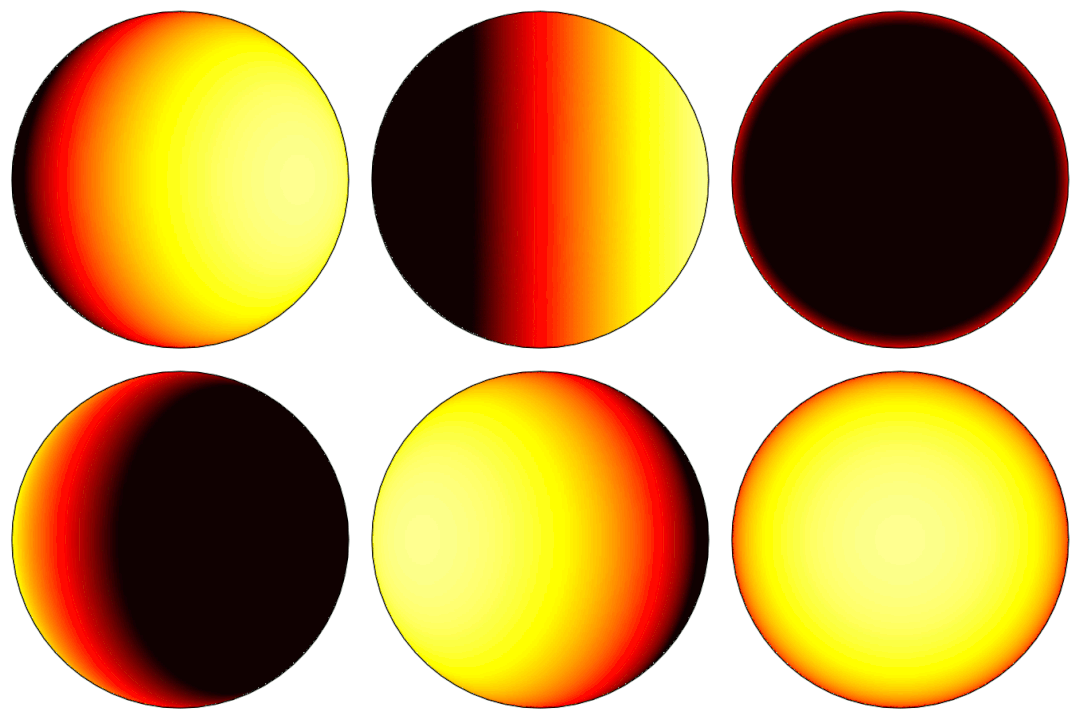
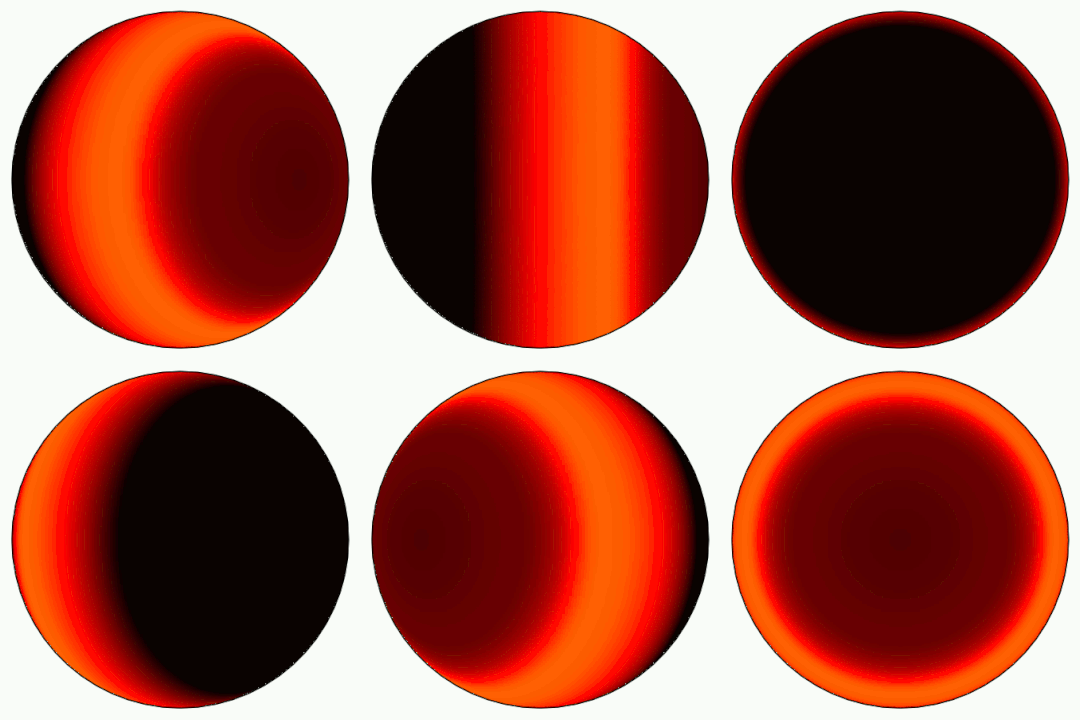
On the left, you can see the observed spectral emission flux (at 8 microns) with
and without absorption by the Δv=1 SiO rovibrational band (assuming an adiabatic
vertical structure). Simulating the atmosphere ends up being tricky due to the
presence of supersonic flows and strong radiative heating effects; as a result,
I developed a custom radiative-transfer and 1D horizontal transport model.
Preliminary results suggest that vertical atmospheric structure plays a dominant
role in determining the observed emission spectrum. I am currently working on
finishing this project and writing up my findings in a first-author paper.
Research Project: Direct Detection of Exomoons
I began this project in 2025, working closely with Drs. Mary Anne Limbach
and Rachel Bowens-Rubin of the University of Michigan.
To date, there have been no confirmed detections of exomoons. Numerous
methods have been proposed to solve this. We were inspired by the efforts
of Lazzoni et al. (2020) to directly detect giant exomoons through
VLT/SPHERE direct imaging data. Our central questions were as follows:
using JWST/MIRI direct imaging data of the super-Jupiter Epsilon Indi A b,
can we detect an exomoon/binary planet? If not, what constraints can we
put on the presence of such companions?
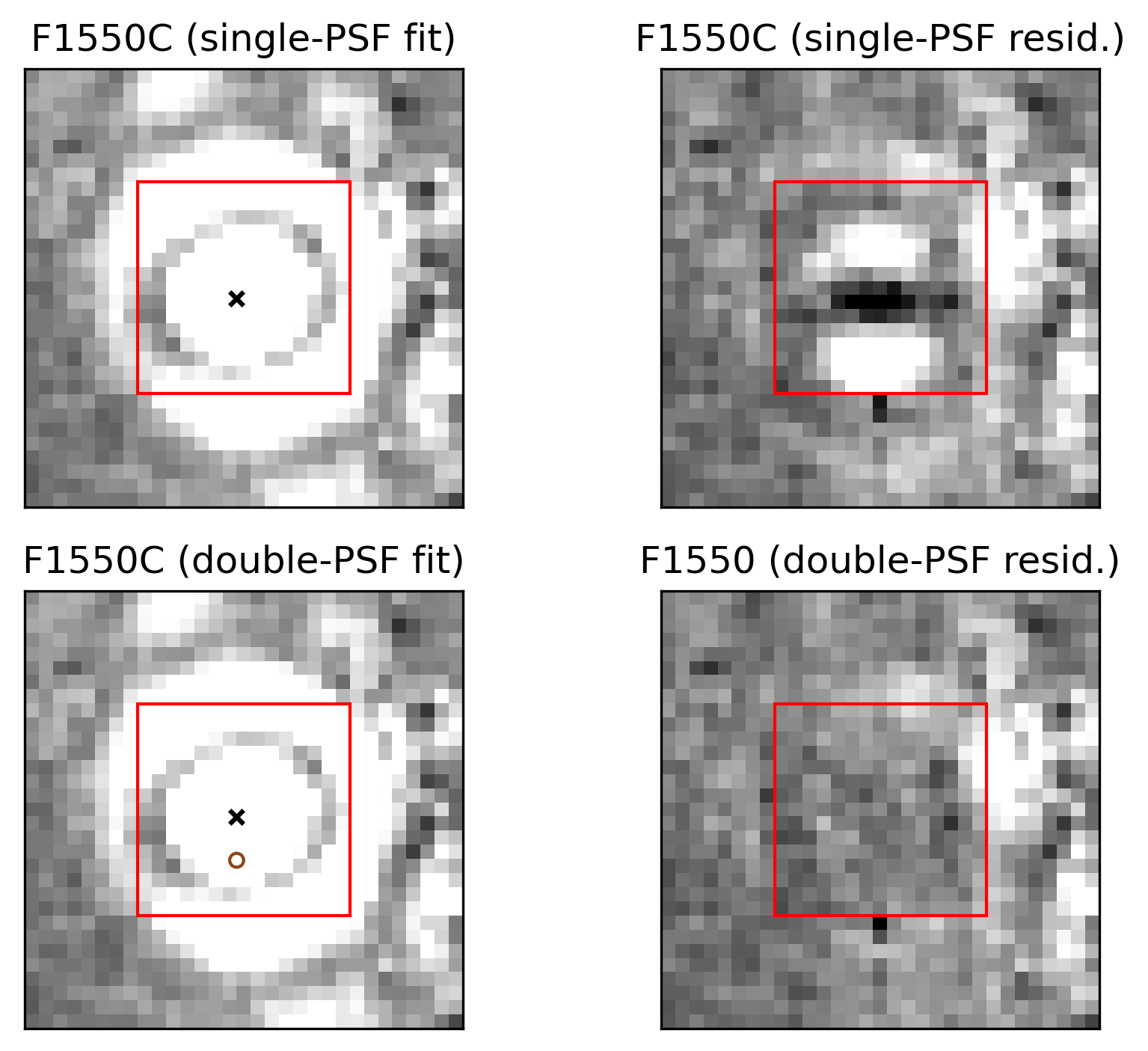
We ultimately settled on using the proven technique of double-PSF fitting.
This was necessary because our data were taken at long wavelengths,
meaning most companions would lie below the diffraction limit. On the left, I
have injected a fake companion at a contrast of 0.2 relative to the real
planet. The fitted location of the planet and companion are shown with a
black X and brown circle, respectively. In this case, we can clearly see
the superiority of a double-PSF fit in the residual column.
Although no strong exomoon candidates were found, we were able to recover
Jupiter-mass companions at wide separations and larger companions down to
~0.52 AU. I've submitted my findings in a first-author paper to The
Astronomical Journal!
Contact
I do not maintain active public profiles on social media sites.
The best way to reach me is via email! My address is matgarza at mit dot edu.
Outside of weekends and holidays, I will try my best to reply within 24–48 hours.
I look forward to getting in touch!